







The Power Duo: How Calcium and Vitamin D3 Work Together for Stronger Bones

by Phlox Pharma | Medically reviewed for accuracy
When it comes to building and maintaining a resilient skeletal framework, calcium is widely recognized as the primary building block. However, focusing solely on calcium intake ignores a crucial biological reality: without its physiological counterpart, calcium cannot perform its job effectively.
Why This Gap Is Especially Common in Pakistan
Most people here focus on "calcium ki kami" without realizing the real bottleneck is often Vitamin D3, not calcium itself. Dairy consumption is generally high in Pakistani diets, yet Vitamin D deficiency remains widespread due to limited sun exposure from indoor lifestyles, covering clothing, and heavy pollution/haze in cities like Karachi and Lahore that filters UVB rays. The result: people consume enough calcium through diet but still develop weak bones, because without D3, most of that calcium simply passes through the body unused.
The Biological Synergy: A Lock and Key Relationship
When you consume calcium-rich foods or supplements, the mineral enters your small intestine. However, the intestinal lining cannot easily absorb calcium passively — it requires active transport proteins to move calcium ions into the bloodstream.
This is where Vitamin D3 comes in. Once synthesized by the skin from sunlight or absorbed from dietary sources, Vitamin D3 is converted in the liver and kidneys into its active hormonal form, calcitriol. Calcitriol binds to receptors in the intestines and stimulates the production of calcium-binding proteins called calbindins.
The Scientific Reality: Without sufficient active Vitamin D3, the body absorbs as little as 10–15% of dietary calcium. With optimal Vitamin D3 levels, intestinal calcium absorption increases to roughly 30–40%.
What Happens When the Synergy Fails
When Vitamin D3 deficiency blocks calcium absorption, the body triggers a cascading reaction. Since calcium is critical for muscle contraction, nerve signaling, and cardiac function — not just bones — the body keeps blood calcium within a strict range at all costs.
If blood calcium drops due to poor absorption, the parathyroid glands release parathyroid hormone (PTH), which signals bones to release their own stored calcium into the bloodstream. Over time, this self-cannibalization leads to:
- Osteomalacia: painful softening of bones in adults due to poor mineralization
- Osteopenia and Osteoporosis: progressive loss of bone density, sharply increasing fracture risk
Why Calcium and D3 Are More Effective Together Than Separately
This is exactly why a combination formula makes more practical sense than taking calcium alone or Vitamin D3 alone — you're addressing both the raw material (calcium) and the mechanism that lets your body actually use it (D3).
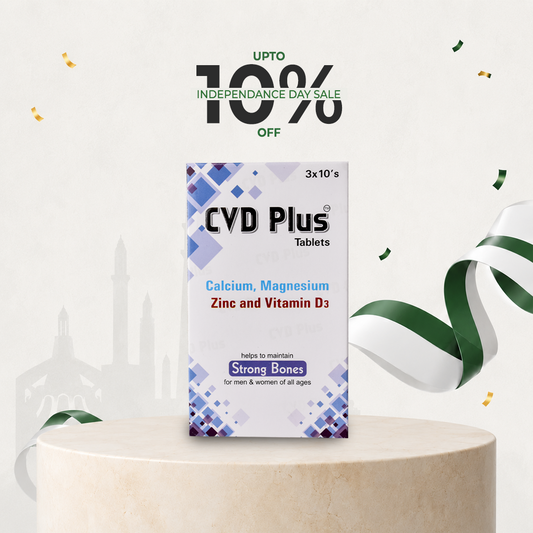
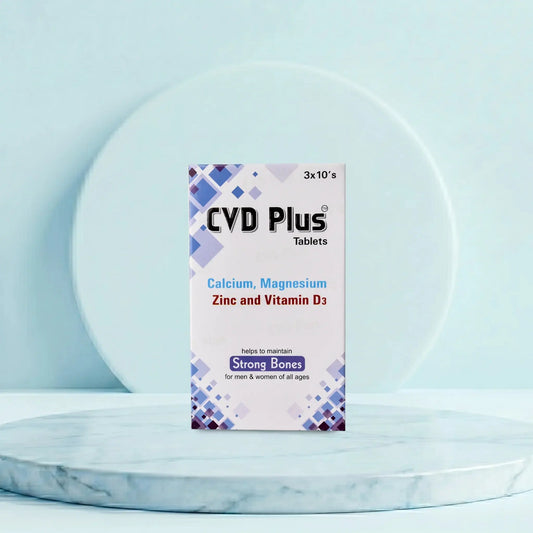
CVD Plus Tablets are formulated around this synergy, combining:
| Ingredient | Role |
|---|---|
| Calcium | The structural building block for bone mineral density |
| Vitamin D3 | Enables intestinal calcium absorption |
| Magnesium | Supports bone formation and also aids calcium absorption |
| Zinc | Supports bone formation and remodeling |
| Vitamin K2 | Helps direct absorbed calcium into bone tissue rather than soft tissue |
This is a more complete approach than calcium-only tablets, since it also addresses the absorption and bone-deposition steps that a plain calcium supplement leaves unaddressed.
Who Should Pay Attention to This
- Adults over 40, especially post-menopausal women at higher osteoporosis risk
- People with limited sun exposure — indoor workers, night-shift workers, those who cover up outdoors
- Anyone with a confirmed low bone density (T-score) result
- People already taking a plain calcium supplement without noticeable improvement in bone scans
Frequently Asked Questions
Can I just take calcium tablets without Vitamin D3?
You can, but a large portion of that calcium may not actually be absorbed without adequate D3 — meaning much of the supplement's value is wasted.
How do I know if I need a combined formula versus separate supplements?
If you already get regular sun exposure and eat a Vitamin D-rich diet, calcium alone may suffice. Most people in Pakistan's urban centers don't fit that description, which is why a combined formula is often more practical.
Is it safe to take Vitamin K2 alongside blood thinners?
No — Vitamin K2 can interfere with medications like warfarin. Always inform your doctor if you're on blood thinners before starting a K2-containing supplement.
How long before bone density improves?
Bone remodeling is slow. Most people won't see meaningful density changes on a scan for 6–12 months, though blood markers for calcium and Vitamin D can normalize much sooner.
Medical Disclaimer: This article is for informational purposes only and is not a substitute for professional medical advice. Consult a healthcare provider before starting any new supplement, particularly if you are on blood thinners, have kidney issues, or are pregnant or breastfeeding.
If you're addressing both calcium intake and absorption together, CVD Plus Tablets combine Calcium, Vitamin D3, Magnesium, Zinc, and Vitamin K2 in one daily formula.


